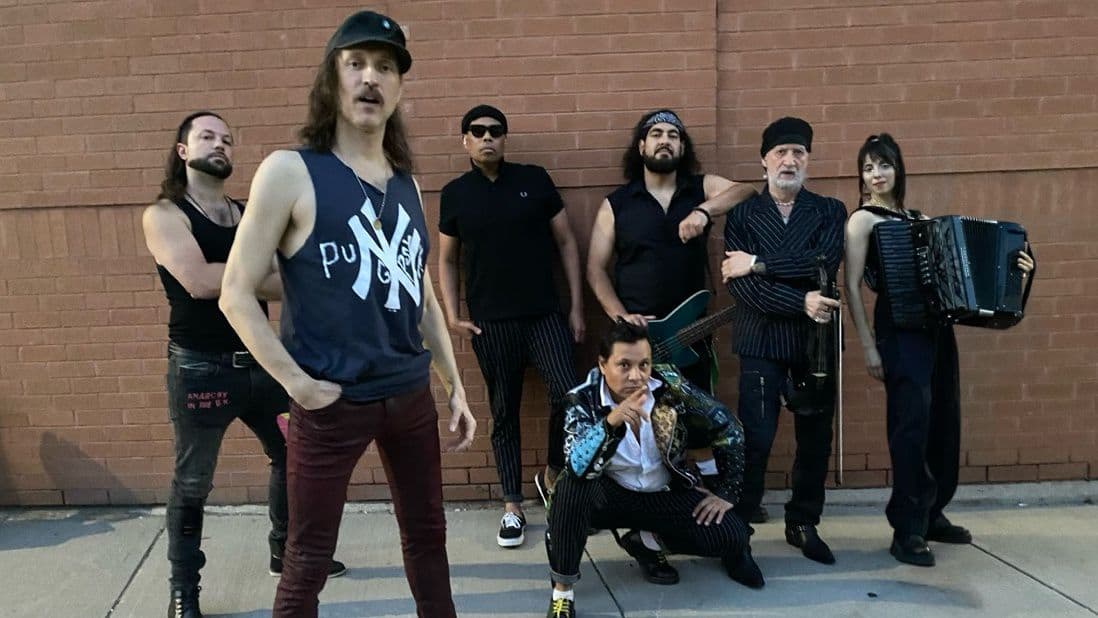
There's no one quite like Gogol Bordello. The band has cultivated a wildly joyful mix of Romani and Ukrainian music, crossed with punk, polka and any other genre that might suitable serve the chaos. Eugene Hütz stands in the eye of the storm, as frontman and ringleader. Growing up in Ukraine studying English language punk and folk, Hütz and family would move across the content to Poland, Hungary, Austria and Italy as political refugees. In the early-90s, the band settled in the U.S. By the end of the decade, Gogol Bordello began in earnest in Manhattan's Lower East Side. Transcript available here.
Eugene Hütz 0:12
The times when the world The world is kind of shaken up by so many things, and we, you know, we're connected to all these things, we're all one organism essentially together. So it stimulates us to do what we do best, which is creating art to counterbalance all the damage that's been done, left and right. So it is been very tumultuous. And on one hand, and at the same time, very, you know, inspiring would be the wrong word, but it's been a, but it's definitely been a very procreative and very cross pollinating. In terms of output, because a lot of people, you know, the hard times, make people that are strong, and, you know, they and the connections, some connections perish, the superficial connections go away, and people have less time for things like that, and, and the connections that have bought and see, you know, they get stronger. So suddenly, you know, you're collaborating with people, that was something that was lingering, maybe in there lurking for a couple of years, suddenly, like, this is like we're doing this now. And so that's, that's been a lot of that has been going on, you know, for example, you know, I mean, I'm, I'm a ministry fan of since ministry, you know, since the day one of ministry, and then I'll all Jurgen said and I met along the way on the festivals previously, but you know, this year we made some music together, it's actually just get announced. So now I can finally talk about it. Of track with all Jorgensen on new ministry album, and all this could also going to do another mix for for Gogol bordello, you know, so just like, and these are real collaborations, this is not like, over the internet kind of thing. So like, if the Postal Service, yeah, we go in with spend time we knock it out out of the synergy in the room. And it has to be all Cammack? And so that's one of them. And then same time, perhaps what MC was referring to that, you know, there seems to be a barrage of new projects every time she talks to me. Perhaps? Well, you know, for years, I was kind of encouraged to do a memoir, you know, that it's like, I was like, well, one of my fucking soccer player, you know, to do a memoir, when I'm there, barely, or a theory, you know, but now more mileage has been acquired. And so I kind of received an offer I couldn't refuse, as far as memoir goes, and it just seemed like the story had enough of art of development to be useful to other people. Because it's got to be useful. I mean, just, you know, talking about your things, you know, who cares? That if it's, if it's actually become something that can serve the purpose for for, you know, for people, and then then my motivation goes up, you know? So working on that, you know, working on that,
Brian Heater 3:58
in this specific instance of the book, what purpose are you trying to serve? Advice
Eugene Hütz 4:03
is a very lame thing to do. And, you know, you know, don't don't advise advise anything to anybody, unless they've really, really asked you and even if they really asked you even then, you know, try and maybe skirt it. In the same time, we do learn from each other, you know, so but I think by maybe laying out certain experiences in a very honest and factual way, actual and factual way you that that becomes useful. And I'm also just judging from my own experiences, I mean, I was always a fan of documentaries, and biographies and it was able to pick out certain things that I found very useful that you know, positive things But, of course those things are manicured, and tons of, you know, mythology and hyperbolized bravado and things like that. But some of them are better than others. So I think that you know, things really can be useful if they're delivered honestly and authentically in non advisor form for me personally, the huge thing is, is a discipline is is I find always ironic that, you know, people kind of, if we spent that time with them, you know, somebody who loves Gogol bordello, you know, comes into a circle of friends becomes introduced to the, to the band's kind of internal vibe, and they're just kind of always perplexed, like, wow, it's like a gigantic informational processing center. I thought it was going to be just like shots of what can I done there? And it's just like, well, how fucking stupid that would be, you know, that's like, a one dimension of it, you know, but I love that that's just almost like, the lowest denominator of it, you know what I mean? And, and I think that, and I love that because it's, you know, when people really figure out what they're all about, they're like, Oh, wow. So this kind of whole goldboro thing. Okay, it makes sense. That's why the BAM has such a longevity. Okay, get it. It's like a, these guys have a method? It's like, yes, exactly. That's kind of what I'm trying to lay out is the power of the method and a power of intentional discipline.
That kind of ties it all together. Because I'm, I'm a really a person who's thrives on discipline,
Brian Heater 6:55
in what ways do you apply discipline
Eugene Hütz 6:59
in a very straightforward discipline, ik self discipline kind of ways. You know, a bit of martial art, a bit of meditation, a bit of drill, just, I'm friends with drill, you know, you know, I befriend the drill when I was as a form of centering yourself. So music is a form of centering yourself and, and yes, of course, and vice versa. And, and the opposite to but for example, him when I went to musical school, which I quit, and I'm not very scholastic person, so it's like, I have to create my own discipline because discipline of other structure drives me fucking nuts. Creator of my own self discipline, my Olympic musical school. You know, I was in percussion and the drumming classes and which was my focus. And they were studying Bolero. Maurice Ravel. Every rock musician loves Bolero and everybody I'm Richard Blackmore, and so on so forth. I think just about anybody, anyone from metal world loves Bolero. It's a highly repetitive, very riff structured kind of thing that just grows grows grows to a clot tremendous climax. And it goes on for about 1617 minutes depending on the orchestra. But in the drummer's job here is to do a quite redundant thing and to be just to be a backbone who keeps marching pattern of Bolero it's such a tedious task and I kind of found some made friends with that I mean, playing Bolero on stage with the orchestra is 16 minutes practicing it with a correct you know older academically rudimentary you know hand drill you know when you're 12 years old, is when you just want to like you know put on Slayer and get on with it you know, which I always did too as well. But you feel me like that aspect of doing something that's seemingly so tedious and and finding yourself as a pretty humble position actually, you know to be a drummer in Bolero it's pretty far from lead. And you're playing basically the most monotonous part of entire thing but Without it, the whole musical piece will collapse. So it's a way of seeing yourself as a part of a greater picture. And kind of serving that purpose. Yeah. I think it was really really actually a great experience. Everybody was making fun of me all my metal and punk rock buddies were like, especially that was practicing with on a rubber drum, you know, on. So you know, just imagine how many jokes were made about that being rubber and you know, repetitive motion and
Brian Heater 10:37
well, okay, yeah, they write they write themselves. That is pretty punk rock though playing a garbage can. It's a drum. And eventually,
Eugene Hütz 10:46
I've promoted myself to that. It's not my fault that fucking the garbage drum sounded better than fucking Soviet drum set.
Brian Heater 10:58
That could have been a good fallback career when you move to New York was the playing the garbage drum. It's a very popular instrument in the subways. Yeah.
Eugene Hütz 11:05
Well, I did a bit of basking here in New York City, did you? Yeah. Luckily, it wasn't too long of a face. But a remember was maybe like 97 or 97 or 98. Maybe it came to a point where it just literally needed a net next, you know, $2 to have a breakfast. So took my guitar, I went up to the 42nd Street. Once I walked out on the corner and started catching fire, you know, when playing, you know, the usual things that I learned Folsom Prison Blues, Elvis Presley color center. And about five minutes into it. Somebody came up and said, Hey, who the fuck are you? This is my corner. I've been playing here for fucking five years. I was like, alright, so like weather on the block? is they're doing the same thing, then somebody's gonna miss it. It has I was just taking a break. And I was eating a sandwich. But this is my corner.
In ours, like, I had guys respect that. Where do you think I should begin that? Well, you better begin somewhere below the Canal Street.
Brian Heater 12:29
You have to work your way uptown. Yeah,
Eugene Hütz 12:31
maybe 10 years later, you know, you'll you'll make it to the West Fourth, you know, I was like, I actually went down to look and I was really trying to find a place to basket. And I did.
Brian Heater 12:41
Were you in like Chinatown area. Um,
Eugene Hütz 12:44
the Chinatown didn't really work for me, though. It was like somewhere like cortile. You?
Speaker 1 12:50
Yeah, like, right. We're way down there. Like on the west side. Yeah. And
Eugene Hütz 12:56
then I tried to West Fourth and stuff like that. But I mean, it wasn't long thing. After like a month of trying to make it work. I was like, Alright, fuck this. Let's just get a job and bookstore and. And I did, you know, got a job in a bookstore in Harlem, in Harlem, through a friend of mine,
Brian Heater 13:14
at very least, it can be very humbling, and it can teach you to play to a non receptive crowd. Yeah,
Eugene Hütz 13:19
totally. It's a great school. It's a great school of realizing that people are going about their business, and they don't fucking care at all
Brian Heater 13:33
New York City. Yeah, especially in New York City, be doing anything on the street, and they would walk past you. Yeah. And
Eugene Hütz 13:40
yeah, it's kind of good. Ego reduction. Practice, you know. I mean, a lot of those Buddhist ego reduction practices, essentially about that, so I was definitely one of them. Is
Brian Heater 14:00
that something that you've had to battle with ego? I mean, you know, that is certainly that's something that people associate with lead singers of rock bands.
Eugene Hütz 14:08
Right? Um, I don't know, see, by that time. I kind of have a strange trajectory in in rock music. So I mean,
I started playing in a band since I was 14. And led by the age I was 15. A rubber band was kind of blowing up in Ukraine on the ground. It was like really, really taken on wings and all the most, you know, prominent people in, in subculture there. They were all over us. I mean, the hippest artists made an album color that, you know, we were suddenly produced by like, the hippest people in in Ukraine and, and they were very, very hip So, after that, you know, I kind of was plucked out out of all of that, and, you know, had to leave it all behind. And, and, and already, even by the time I kind of experienced, kind of like all the most negative aspects of being in a band, I mean, we were young, you know, everybody's bravado is out of fucking control. And, you know, you know, all kinds of girlfriends theft, you know, one guy steals a girlfriend, all this kind of thing went on, like, in a first European event, it was a turmoil, while still going through herself, like not speaking and still continuing to play, because music was the sacred thing would be held as the most important core of it all. So I got pre kind of burned quite quite significantly by that and just like, on level of just all the way into physical fighting, you know, and I were kids were kids, you know, we're in a, in a very tough environment that was, you know, we lived in a very industrial part of the city very much like an abalone it's an outskirt it's not a suburb. It's an outskirt it's like, there's, there's no gardens or heel fountains. This is just like a rough cut. Me? No, it was, it was a time of as they call them, the informal, informal unifications of youth, which here in America called gangs. And that were, you know, some of them were quite benign, and some of them were quite malignant. And they were and we were all parts of this subcultures that were completely mutating all the time and you'd have to constantly watch yourself over the shoulder. And so the band kind of had to also pretty rough cut vibe and some sounds you know, this was a lot of this was a time when you know, punk rock and was kind of getting replaced by the skinhead movement and I mean, I of course mean anti racist, skinhead, rude boy style original boy very cool. You know, a lot of my friends went into that and but it was it was music and art that was connected to the street you know, like we weren't art students who were singing about gangs like blue
Brian Heater 17:51
collar
Eugene Hütz 17:52
we were blue coral color guys who were in this informal unifications of youth singing about art you know, was more like that. So you know, there was a lot of kind of burn up and in that environment along with the excitement and so then I was just kind of plucked out out of it and put an immigration in where I lost that whole aloof you know, Bohemian laugh lifestyle, any element who was just gone, I was working in construction in Italy, like, you know, and working and working in a winery and working fucking washing car cars and shit like that. So for like, a year, you know, and it took a while to you know, we already came here originally when I was stationed as a refugee, you know, with my family in Vermont. So it took a while to rebuild that and starting a band there and you know, becoming a part of hardcore scene there and and then I had because Vermont is such a great you know, a cradle of it's a great crib in a home for just, you know, for music and writing. Being being kind of just being an artist really, it's really hard or just friendly. I rebuild a that you know, kind of got back to a vibe I was in beforehand. Just things dissolved the game for whatever cosmic reasons, you know, and I moved to New York and I had to scratch from basketball again. And, and it was this kind of became a fucking pattern where the I was just like, Alright, I guess it's just gonna help fucking gifts. Like, like, sell Like I already had enough practice of this, so it wasn't so frustrating by the time I guess that's what you're asking
Brian Heater 20:10
us jarring at that point, I was like, alright, it's that fucking thing again. Let's do it. When you say things dissolved in Vermont, what do you mean? Well, we
Eugene Hütz 20:17
had a band. And I mean, I had, I was in several bands in Vermont. One band was epitaph was a hardcore band was very much like, along the lines of New York hardcore. Floor, like, inspired by leeway. And slightly, maybe, like biohazard and you know, little metal industrial rational. Yeah, crossover thrash, you know, full on like Crump soccer is a little bit this. And and then, you know, there was, I mean, it was a really great time for hardcore music, there was just streaks of hardcore, like, every time we went to a show there was like, wow, now there's Hari Krishna Harcourt was going to go, shelter was coming out with this super strong, you know, Hydra Krishna hardcore kind of thing, which, of course, they took from kromaggs. But still, it was very, like new school. And, you know, there was quicksand, you know, was Walter doing kind of a post hardcore thing, just like, a year later. It was just, the evolution of hardcore was just amazing, you know, it was quantum leaps all the time forward. So we were kind of on that train following closely, oldest developments. And then, at one point, you know, I was like, I'm a punk rocker, you know, I just, it's where I live, you know, suddenly, something just led me back to this original, speedy you know, and rancid, came out with a, you know, first album, and I was just like, this is this is kind of where, what, what is what it's more about, for me, you know, it's, I need to play this. So I started kind of a punk revival is the band. revivalist? I mean, I just left band in Ukraine. Like, that was like, full on, full on like dead, Kennedys GBH, you know, band, and now I was a revival and punk and three years later, okay, so but this band was, we called the fags and, you know, because the more like the, the red nicot the rednecks in Vermont would call us, you know, flags when they will see us on the street. So you know what I mean? So we're like,
Brian Heater 22:35
I like it's kind of a rough name in today's context.
Eugene Hütz 22:38
I know. I know. But I have to own it because it's, it's a tight it's a comes out from that context. And we were literally thinking I think Dan, I think Dana or drummer looked up this thing they entomology, slang, five. And it lit well, actually, it was really interesting. It was a rough one because it leads back to Inquisition. You know, I mean, being tied to a pole. The pole a fag is being is was basically a slang for being a heretic. So it was either to heretics, which was there was a band in Boston that called the heretics and or the misfits, which was already taken. So how do we, how do we side with the dispossessed and uprooted and the misfits of the world? And that word was, it was kind of, you know, very punk rock, spirited way of displaying that. So in context of the time was great, because every band we played on the bill with was had a name that was just as offensive, like, you know, seven year bitch or,
Brian Heater 23:56
or something around then. Oh, we
Eugene Hütz 23:58
played with that. Yeah, totally. Totally. That was there was there was a time capsule where if your name wasn't the fans of the like, you wouldn't get a gig. Yeah, I mean, there was a reason why things happen in particular time. And there's a reason why the fags dissolved and because it wasn't really, it was kind of a trampling for an I mean, we gave it the 100 We gave it 1,000% we would treat it very seriously. We rehearsed nonstop for five days a week. But it was a great trampling to once again, strengthen the muscle, you know, commit yourself to the drill of music and develop, you know, develop confidence into your muscle and, you know, when we split up, everybody kind of went their separate ways, but continuing to pursue music up until to this day, you know, in different parts of the States at this point, but I think that we had a run and you know, they I moved to Austin, Texas at that point and continued playing with rockabilly bands. And now his new band is called bad light. Which is kind of more like alternative blues. And very interesting, artsy, kind of, and
Brian Heater 25:21
obviously, a culture shock, you know, moving to Italy and then moving to the States, but when you first arrived in Burlington, how did you seek out like minded people? That
Eugene Hütz 25:32
was no difficult and in fact, I didn't have any cultural shock. And that's a that's like a often made assumption, but what culture shock I mean, I went from one group of guys who were punks and skins and into into into another, like with,
Brian Heater 25:49
with culture shock would it is a universal language, isn't it punk rock
Eugene Hütz 25:53
it is. And, and it's, it's fantastic that way. Because this is a very working class kind of intellectual kids, you know, who gather around musical fire and, and the exchange, you know, a lifestyle that's fairly, you know, unpretentious, and sticks to the kind of delete this class struggle out of their way. Because, I mean, who the fuck wants to deal with it? You know, class struggle goes on. But in that context, it's irrelevant. I mean, once you know, everybody who's been in New York, in a, in a, in a real thriving punk scene, they know that it's kind of it's a kind of equalizer. You know, it's more, it's usually based on majority of people are from working class, who have artistic aspirations, and have great taste in music. And, but there is also like, you know, people who are like sons of millionaires who are there and, you know, people who are various different walks, but that becomes irrelevant, you know, that's their, their social status just goes out of the fucking window, once they're in that environment. And it's a kind of serves that social equalizer can't afford it's a great, great way to be.
Brian Heater 27:29
I was talking to somebody about this the other day that the lead singer of Link ad is Daniel steals, or was Daniel seal son.
Eugene Hütz 27:38
Yeah, I think if you dig deeper, you'll find more examples like that. But that, that is totally great. Because it brings people together under a greater cause than social climbing. Or, you know, this kind of career, you know, opportunity seeking. And then these people who say they have some dough kicking around, they start to start labels and without these other kids records, and they kind of, you know, bring the resource to a better cause then, you know, fucking you know, otherwise. Yeah, sir. class struggle.
Brian Heater 28:19
I, there's a sense in which it goes away, but it's also very present in that it's, it's fodder for the music itself.
Eugene Hütz 28:26
Yeah, it's a super complex issue, but and cluster, I was always there, it always leads back to class struggle, you know, and, of course, because there's such a huge middle class, it's, it's kind of more diluted, but I don't know. I mean, I can't undo my upbringing. You know, I mean, which was, which was, I mean, most of people in my family were working class or artists, you know, professional artists. Or they were at least hobby artists, but for me, like even the artist, like my father's brother, my uncle kind of babysat me a lot I kind of grew up in his painting studio, you know, with him and all his friends have long hair and pants covered in paint and you know, listening to some crazy ass prog rock or craft work. When I was like, five years old already, like was listening to craft work with them, you know? Can they still kind of had a very drill approach to it. Like they were, they were still connected to the fact that, you know, there were kind of very pulses on about it, you know, like Suzanne was a kind of paint out of the just considered himself being Very crafts, you know, it's like, I could be doing this or it could be doing furniture, you know, it's just like this what this what I do I do this professionally. If I'm inspired a fucking pain, great if I'm not inspired, I just keep paying, and it's still going to be pretty fucking good, kind of edited. And it wasn't a whimsical poetry kind of for I'm inclined to write a poem now. So I do and if I'm not, then it's like, it wasn't, it's like, no, it's on. Because I'm a professional. That kind of thing.
Brian Heater 30:39
What's the experience like have in the process of working on this memoir of going back and I guess re examining various aspects of your life early on.
Unknown Speaker 30:50
In a way, this
Eugene Hütz 30:52
memoir is kind of inspired by the documentary that just came out in on the band, the girl BARDELLA story. And documentary is, it's came out, you know, it's at the festivals right now, you know, premiered in Tribeca Film Festival and and then now I'm basically going up like every other week, flying out to one or another thing. And I think is doing definitely, it's, it's received greatly. But the commander, you know, it's an hour and a half and telling a story of a community. You know, Gogol bordello is it's not so really a band. It's more like a community, you know, and actually, community is even wrong word. It's
more like a Gregor. In is a Tarik field, they have this term ag Gregor, which is kind of describes this cluster of energy that sort of exist as a form of a cloud.
And kind of unifies sort of like a collective collective consciousness of the, of the group of people that kind of sort of has certain spell over them. You know, it's like, go figure who is guiding who? Yeah, so, and it's an interesting way of looking at things. And, uh, sometimes I feel like there is some truth to it. Because over and over is kind of its, its, its lives on its lives on its own, and kind of has its own trajectory, you know, and bring certain kinds of people together. And then, an hour and a half, it's just impossible to tell that story. And it's just impossible, no matter how crafty. You know, Eric weinrib, who is an amazing producer and writer, and you know, Beverly and Nate, and the editing team is amazing, Paul lay in a maximum respect, the film works really great. But the the memoir y toolkit, finally, this offer to do it is because it's kind of want to, like tell this, now that that story is out, and it filled the holes that documentary couldn't really go into. It's almost a kind of like a companion piece to the film. Say you saw the film. And that there was a lot of cliffhangers there, you know, the film, couldn't afford to go on some of these things that I already want to talk with you about, you know, the roughage of, you know, use that we had and stuff like that. And I thought, wow, you know, what, this actually could be great if they can work together. So that's kind of that's kind of the idea behind
Brian Heater 34:01
it. You know, your youth will be a piece of the book as well. Yeah,
Eugene Hütz 34:05
I mean, yeah, for sure. For sure. It's kind of there's a, it's a big focus on it.
Brian Heater 34:13
Obviously, you know, it's your life and you live through it. I don't know if it felt extraordinary to you. But, you know, from my position, you've absolutely led an extraordinary life.
Eugene Hütz 34:22
Well, thank you. I mean, broadly, it appears to be like that, in a certain sense, but I also kind of would
shy away from being kind of portraying it as sort of this like, Hey, here's a story from behind the Iron Curtain, you know,
because I'm trying to connect more dots while telling my story. That a lot of a lot of culture that's here that you know, as quintessential Western culture, even American culture, downright American culture. It has deep roots back there. And it, it kind of when you connect these dots, it's a very interesting mosaic. You know? Ramones is a icon of New York. And the same time, you know, the fall fall, one of the founding members of Ramones, Tommy Ramone was born and raised in Budapest, you know, and he left Budapest for exactly the same reasons why I left Ukraine, because of the Soviet invasion. You know, I won crawl, you know, from Patti Smith's band and, and from, played with EA, for years afterwards was left, you know, born and raised in Czech Republic in Prague. Left with his family, Prague for exactly the same reasons that I did. Because of Soviet invasion one more time, Russian tanks rolling in what else is fucking new. And that those are not passing characters in, in punk rock desert, people who are deeply in the making of punk rock, you feel me like
Brian Heater 36:21
sounds like there's, there's a line to walk between, you know, sort of the the not, I'd say novelty of it, you know, of being the story that might not be super familiar to the reader, but also trying to make find ways to make it more universal.
Eugene Hütz 36:38
That's kind of where I'm getting it. Because the story goes on. I mean, it's actually I'm, I'm kind of propelling the story myself. Because of my personal research that I've done in data connected. And every time I connect new dots, I get more excited about it, you know, like, you know, going back farther to like Andy Warhol, you know, with his deeply Eastern European roots, you know, and, you know, it was him who gave to Lu, Venus and first book by once again Zacchara Maza, who was a Austrian Ukrainian author who wrote it in Lviv in Ukraine.
So, you kind of it's just like that part of the world has a lot of
global influence. And it's an even, even now, I was just like, in Ukraine in in September, right. And it was my birthday. And I wanted to go to Ukraine for several reasons. And also, you know, go and see my family and make sure everybody's doing okay, and spend some face to face time and on. And I was in a small town outside of key of boy Arcona, where I was born and raised, like, talking about before, five years old. And my aunt who lives there now. She was scared of like, told me that while you know, Shalom Aleichem wrote Fiddler on the roof here. I mean, he wrote it in Boyko, like, down the street. I was like, no, wait a second, you were just hyping the Ukrainian cars now. You know, which I mean, I'm in you know, sure. But it's like just kind of you're hyping it too hard a little bit, you know. All the roads can't lead back to Ukrainian. And she's like, I'm not saying this. But this is. This is a simple fact that it was written here. And he wrote it about people here in Boyer. And I was like, God, let's look it up. So like, I go look it up and on there. It isn't wide open knowledge that I don't know. How the fuck I didn't know
Brian Heater 38:58
this. I was gonna say, you know, like, it's small town. It's wild that you today never Yes.
Eugene Hütz 39:04
To the end, the dairy man, the key character of, you know, the official of Fiddler on the Roof. Yeah, he was an actual guy who was living in Boyka. And then he moved into this other village that called the zoo reacher. Just five kilometers away, and I biked all the way over there, you know, that same day, just to see. And, you know, it's an interesting mosaic of elements and how embedded there already are in global in global culture, you know, and, and I find it to be just so interesting. It kind of makes me feel home as a as a transplant. You know, here, it makes me feel a lot more home, that I realized that those are actually bits and pieces. CES of where it came
Brian Heater 40:00
from, you know, last year you did a cover of the Pogues you did it with, with Jesse man. Yeah. And yeah, Jesse is having his own struggles right now. But, yeah, this podcast, Shane McGowan just passed overnight. He was a big influence. And you met him? At least Yes. Yeah.
Eugene Hütz 40:21
Yeah, I met him several times. My change several times. It's been a sad morning, you know, I've been I walked up to messages flooded with. And I mean, just about everyone I know, either was a maniacal fan of Shane or, or friend or colleague of Shane, you know, you know, or, you know, it's just this once you pull up any picture of Shane and look into his eyes, and it's, it's absolutely a singular iconic soul. And he has a portal eyes, you know, where it's so it's just Dionysus in, in walking amongst us, you know? And and somebody who could put all the, you know, talking about working class intellectual, right there is pretty much the high priest of,
Brian Heater 41:33
of that this Irish tradition like this James Joyce, kind of storytelling tradition.
Eugene Hütz 41:41
Yeah, yeah. A particularly great poetic storyteller, who just had such an effortless knack, seemingly effortless, of course, it was craft. But I think that I think it's, it seems so easy for Shane to write in a way that was unattainable for other people. Just unattainable. I mean, there's other people who are toiling away trying to sound you know, epic and timeless, but in case of Shane, it was really epic, and really timeless. And it's, and it looked like he's just taken it out of thin air, you know, and you could read his lyrics as often, most of the time. Rock lyrics don't work as poetry on paper. I mean, I mean, so rock layers has released them has poetry books, but they really don't don't work. Actually, most of them they don't. It's like, hey, let's not fucking fool ourselves. Rock'n'roll is not high art. Its art, but it's pretty democratic form of art. You know, it's, it's, it's it's a it's a portal for artistic souls, but I don't know if it was so rare, rare cases. Of course, it reaches its pop art. Its pop art and maybe, you know, maybe Joy Division, you know, reached actually high art, you know, frequencies in on the second side of closer,
Brian Heater 43:13
you know, I know you put Shane up there with like, like Nick Cave, or Leonard Cohen of these people who turn? Absolutely.
Eugene Hütz 43:22
Absolutely, actually, probably even maybe, maybe, actually, I mean, I think he might be actually even in a singular league here. You know, as I said, you know, it's interesting, I, you know, obviously looked in into Boolean art coin and kind of, quite deeply and, and kind of into his craft. And he's known for toiling away for ages. I mean, it took 10 years to write.
Brian Heater 43:57
Hallelujah. He's a poet. He's without, you could take his lyrics. That's an example of somebody you could put in a poetry book. And he did.
Eugene Hütz 44:05
Yes, yes. Yes. He's, he's definitely that, but Shane kind of had a, I don't know if he, from what I know, he doesn't have songs that he wrote for 20 years, it seemed like he was just exuding them, you know, and putting them together quite quickly, and that it did have a lot of a Gonzo vibe to it. You know, it's just, it's just, they all sound like he woke up in the morning and, or, you know, stroke him and he just laid it out and then maybe finished it one more time later, like a jammy
Brian Heater 44:35
error, that kind of thing. Yeah. Yeah. And it's just such a powerful thing
Eugene Hütz 44:40
to do, because most of us can do that. Yeah, it's
Brian Heater 44:43
hard. It's hard work to make something look effortless. So yeah,
Eugene Hütz 44:48
I consider it to be pretty fucking unattainable level of poetry.
Brian Heater 44:53
We were talking about him and that specific song I have to ask how how Jesse's doing these days.
Eugene Hütz 45:01
Well, we're in touch, you know, I miss him, I miss him just see him regularly. You know,
Brian Heater 45:09
he was kind of around town kind of guy
Eugene Hütz 45:13
around town and extremely helpful. And I mean, just going on and get a drink. That's one thing, but also, that's regular. And I have Jesse's always a guy who just gets drinks for everybody and makes sure everybody's having the best possible time with, with whatever, wherever they are about, but it's just we just I think that just everybody's missing, missing him having him around the block and being being part of the community, you know. I mean, I don't think the New York City would be anything like what it is at this point without, he's kind of he's a he's a keystone species, you know? Yeah. Yeah.
Brian Heater 45:57
Yeah. Pete Sounds so sounds like New York when he speaks.
Eugene Hütz 46:02
The sounds and blasts. I mean, it's a fact. I mean, he's been providing his venues to. For people to do to, to, to keep to keep some of these clusters of culture. Yeah. Just like, his venues are the only portal for these certain clusters. You know,
Brian Heater 46:28
it's hard to New York City. You know, it's so expensive that, you know, you can't really make a living being an artist here. And that, you know, I live in Queens. It's gentrifying, too, but the transformation that Manhattan's gone undergone in the past 30 years, it, it seems like there is this, like, marked effort to take culture out of it.
Eugene Hütz 46:54
Well, that's a very gruesome statement. Yeah, at the same time, I do know that people still persevering while being an artists, you know, I think some of it is kind of coming back. You know, and it's
thankfully to people like Jesse Emmett, some of it is coming back actually to Manhattan, because, you know, there is a limit on
on all this things are just describing to and it's also it's just, it's remains to be historical, and Manhattan remains to be an island with it, extremely, highly energetically charged soil. There's just nothing you can do about it. And this is a it's a fact that someone told me
sorry, someone told me I think was so Williams actually who told me that Mahanadi Indians, you know, the first nation that was living here
the Dutch I mean, I know he told me this the sounds very truthful to me that they weren't people that this is a very extremely high energetic soil and you can't really this isn't a place to chill and sleep, this place to do biz and hunt and do more how higher Atlanta energy activities, blue cow how that's applied to the to the rest of the New York history.
Maybe some of this is a Tarik competence, you know, we'll preserve Manhattan for as also have that Niantic cultural elements, you know, I mean, I just don't feel the same outside of Manhattan. You know,
I feel I feel feel here I feel quite significantly in the pocket and just for who I am, because, you know, see in Vermont that constantly felt like I was a Mac, you know, you know, I was walking a lot faster than other people. And, you know, and here I just kind of walk around the regular speed with everybody. It seems seemingly, you know, yeah, it works for people like with work with worse for people like me. I've been here
Brian Heater 49:41
for about 20 years, and I feel exactly the same. But I was reading I don't know if you've read the Thurston Moore's book yet. That came out. Oh,
Eugene Hütz 49:48
that's, I'm taking it on tour. Okay. Yeah. So it's, yeah, you
Brian Heater 49:52
know, it's very much about New York City. I mean, and it's very much about the band horse. It's Thurston Yeah. And a big part of it is unknown. I've seen in the New Wave scene and there's that that famous Brian Eno produced compilation that came out. Yeah,
Eugene Hütz 50:08
of course with James chanson DNA. Yeah.
Brian Heater 50:12
And I was I was just reminded of that, because, you know, the, you've got this label that you just started up, and it seems like it the goal is sort of similar.
Eugene Hütz 50:22
Yes, actually, very much. So, I mean, I was very excited to start noticing that kind of a resurgence of no wave of inspired young bands in New York is starting to bubble up. You know, and in the circumstance, probably, it's, it's extremely exciting for me, because anything that's plasmatic and can help control yourself five times and the bringing on, you know, I think he's just such an important you know, part of, I can't imagine New York without no way or New York hardcore. Yeah, that's just like New York doesn't exist without it. It's real, energetic entity. So, in a certain sense, probably, it's worth connecting these dots and kind of curating these these manifestations, you know, and bringing them together and making some builds together where we're actually going to be there's an idea Well, Eric Sanko is one of the great you know, participants have no way of you know, and James chances colleague, you know, just talked the other night about doing a gig together. And we're gonna land it probably in January or February here in New York City as a kind of, you know, wave passed the torch event with some some pioneers and some newbies, you know, and I think it's just such a, I get excited about things like that. So just kind of things I live for and so do my small part to give it back to the city that that gave me everything event, essentially, you know, it's here that I've started to feel like I'm not some marginal Freak a Holic it's here to the I could gather kind of a band that that was more than a band for few year community and Gregor and all those things we talked about, and I found understanding, great understanding hear from some people.